Monitoring and Evaluation
Significance of Monitoring and Evaluation
Monitoring and evaluation enhance the effectiveness of RDE programs, projects, and activities of
the Cagayan State University by establishing clear links between past, present, and future
interventions and results.
Monitoring and evaluation helps the University extract, from past and ongoing activities,
relevant information that can subsequently be used as the basis for programmatic fine-tuning,
reorientation and planning. Without monitoring and evaluation, it would be difficult to judge if
the work is going at the right direction, whether progress and success could be claimed, and how
future efforts might be improved.
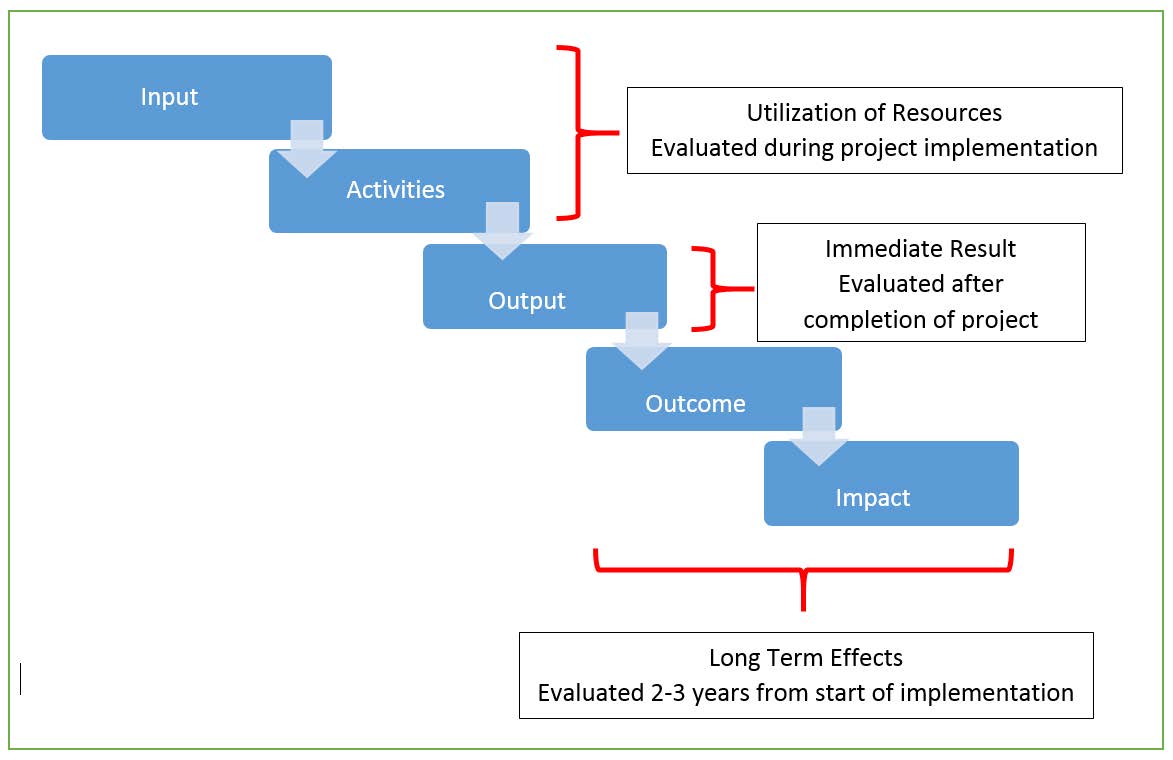
Performance evaluation will assess the project’s success in achieving the outputs with the
inputs provided and activities conducted. Evaluation of the project’s success in achieving its
outcomes will be monitored continuously throughout the project. Reliable baseline data will be
collected at start of the project activities, and impact data will be collected when appropriate
during the project implementation.
RDE Monitoring and Evaluation Framework
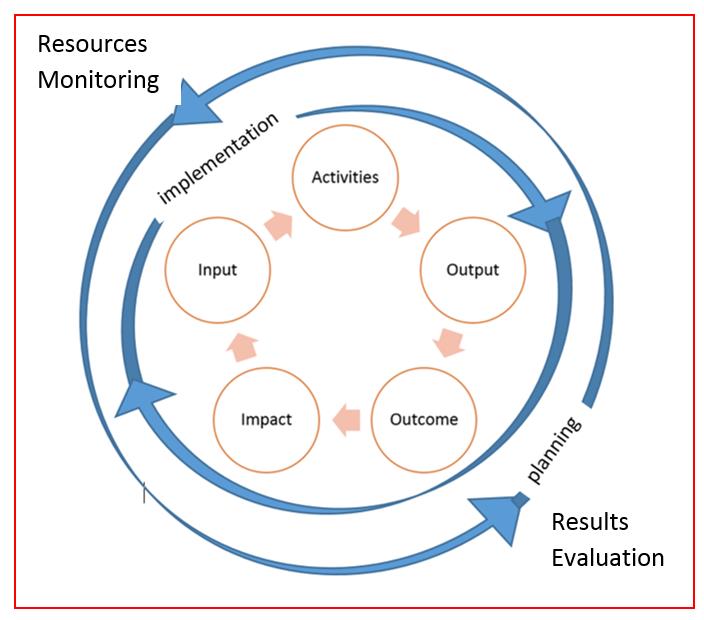
Monitoring is a continuing process that provides stakeholders with early indications of progress
or lack thereof. Evaluation assesses progress systematically and objectively toward achieving an
outcome.
Evaluation is a selective exercise that attempts to systematically and objectively assess
progress towards the achievement of an outcome. Evaluation is not a one-time event, but an
exercise involving assessments of differing scope and depth carried out at several points in
time in response to evolving needs for evaluative knowledge and learning during the effort to
achieve an outcome. All evaluations—even project evaluations that assess relevance, performance
and other criteria—need to be linked to outcomes as opposed to only implementation or immediate
outputs.
Inputs are the goods, services and other resources provided for an activity with an expectation
of producing outputs and achieving the objectives of the project. RDE program inputs consist of
the manpower and the other resources needed for the purpose of attaining the RDE program
objectives. RDE program, projects, and activities are actions undertaken in order to execute and
implement the plans.
Outputs are the specific products or services resulting from the application of the inputs and
can be a by-product of the process of undertaking RDE. Program outputs are the physical outcomes
produced by the program and measurements of services provided.
Outcomes are the changes in policy, process/practices and/ or products that result from
adaptation of the project outputs by intended users.
Impacts are the results of the project outcomes. These are the aggregate effects of changes in
practices, products and policy. Impacts may be classified as economic, environmental and social.
Program impacts are the changes in the environment as may be brought about by the program.
Impact assessment is intended to determine whether a project caused the desired effects on
individuals, institutions, and other stakeholders and whether those effects are attributable to
the project intervention. It is assumed that the project’s intended impact is a function of the
project’s outputs which in turn depend on the project’s inputs.
Policies and Guidelines on Monitoring and Evalujation
All RDE Programs/Projects/Studies/Activities (RDE-PPSA) shall be financially, physically, and
technically monitored and evaluated. This includes ex-ante, on-vivo, and ex-post evaluation.
RDE- PPSA shall be monitored and evaluated to determine whether the objectives, desired outcomes
and impacts are efficiently achieved.
RDE Programs/Projects/Studies/Activities (RDE- PPSA) included in the Medium Term Development and
Investment Plan (MTDIP) and Strategic Plan duly approved by the Board of Regents, shall be
implemented with corresponding funding support from the University.
For RDE programs, projects, studies and activities (RDE-PPSA) not included in the approved
Medium Term Development and Investment Plan (MTDIP) and Strategic Plan but anytime within the
year, the P/P/A is thought to be essential and with potential impact to the community and the
University. A duly approved project proposal is required if funding is sought from the
university.
Monitoring & Evaluation of Students’ Involvement in Rde
The Deans through the College RDE Coordinators shall monitor, coordinate, and consolidate
students’ participation in RDE programs/projects/studies/activities (PPSA). Report shall be
submitted to the Campus RDE Directors and to the university level.
Monitoring and Evaluation Responsibility
-
University Monitoring and Evaluation Team (UMET)
The composition shall be:
- Chairperson: Vice President for Research, Development and Extension
- Vice Chair: University Director Concerned
- Members:
- Other University RDE Directors
- Internal Audit Service
- University Finance Officer
- University Planning Director
- Secretary/Documentor
-
Campus Monitoring and Evaluation Team (CMET)
The composition shall be:
- Chairperson: Campus RDE Director Concerned
- Vice Chair: RDE Coordinator Concerned
- Members:
- Campus Planning Officer
- Campus Finance Officer/Accountant
- College Dean Concerned
- Secretary/Documentor
- The monitoring and evaluation teams shall include experts in the field or discipline of
the
project.
- The team must utilize the prescribed RDE monitoring and evaluation forms and must
conduct a
post-evaluation conference with stakeholders.
- The Finance Department shall conduct financial monitoring and provide information on the
status of project funds to the VP-RDE.
- The VP-RDE Department shall also monitor the assignment of project personnel – project
leaders, RDE staff, and laborers, including requests and advice for sub-allotments and
other
pertinent documents related to the project.
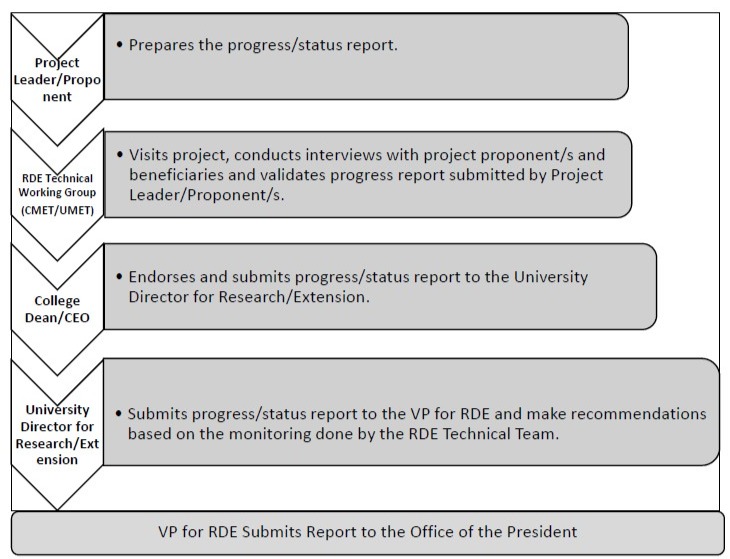
- RDE project leaders and staff shall be required to submit periodic reports using
appropriate
monitoring and evaluation forms.
Monitoring and Evaluation Strategies
Field Visits
Field visits are frequently used as a monitoring mechanism. Consideration should be given to the
timing of the visit, its purpose in terms of monitoring, and what to look for in order to
measure progress. Visits are usually complemented with key informant interviews, household
interviews, and focus group discussions with project stakeholders, beneficiaries and partners.
Visits shall be conducted monthly or as the need arises.
Agency In-House Review (AIHR)
1. The agency in-house review has the following objectives:
- Evaluate all ongoing and completed RDE programs/projects/studies/activities.
- Identify problems met during project implementation.
- Identify significant results/information for Technology Dissemination (TD), Technology for
Packaging (TP), Technology Utilization (TU), Policy Formulation and Development Planning of
the University.
- Identify new RDE projects that are within the priority areas that would impact on the lives
of the beneficiaries.
- Identify cost-efficient and effective projects ready for Information Dissemination,
Technology for Packaging, and Technology Utilization.
2. The Agency In-House Review (AIHR)
The AIHR is composed of two parts:
- Evaluation of ongoing and completed RDE programs, projects, studies, and activities (PPSA).
- Planning workshop for the succeeding calendar year.
The accomplishment being reviewed covers one calendar year (January-December) and shall be
conducted every December.
3. Evaluation and Review Process
- All ongoing, completed RDE projects, whether internally or externally funded, shall be
evaluated through presentations during the AIHR.
- On-going and completed projects shall be conducted at the University level.
- Based on the findings of the evaluation, the project may be recommended for continuation,
extension, termination, or revision.
4. Campus-Level Review
An in-house review must be conducted at the campus level for project proposals following the
procedures in Chapter 4.
5. Terminal Report
For completed projects, the Project Leaders and staff must submit a terminal report within thirty
(30) days after completion and present the results in an appropriate RDE forum.
6. Reporting Requirements
- All ongoing RDE programs must submit progress or status reports.
- All completed projects and/or research must be presented during the scheduled AIHR.
- All Project Leaders must submit a technical paper for publication following university
policies.
7. Equipment and Facilities
All equipment and facilities acquired from externally and internally funded projects should be
turned over to the university supply office or provided with a Memorandum Receipt (MR) to the
project leader.
8. Compliance
All project leaders must satisfy all the requirements of the university/funding agency/ies.
9. Presentation of Completed Projects
For completed internally funded projects not presented during scheduled AIHR, the proponent is
given another chance to present during the next review.
10. Outstanding Contributions
Outstanding Extension Worker and Best Extension Program shall be selected during the AIHR and
validated during on-site monitoring and evaluation.
Reports
- Reports serve as the basis for assessing the performance of programs and projects.
- All reports shall be submitted in both hard copy and electronic formats. Photo documentation
is required.
- A quarterly and annual Audited Financial Report (AFR) shall be prepared and submitted to the
VP-RDE and the funding agency.
Submission Schedule
- Campus annual reports: Second week of December.
- Annual results report: Includes assessment of outputs, indicators, challenges, and
recommendations.
Required Reports for Completed PPSA
- Technical reports
- Audited financial reports
- Journal-type report (for refereed and accredited journals)
- Popular publication (for IEC)
Monitoring & Evaluation Report Calendar
| PHASE |
REPORT |
SCHEDULE |
| Before |
Project proposal |
December and June |
| During |
Quarterly Accomplishment Report |
1st Friday of April, July, and October |
| During |
Annual Progress Report |
2nd week of December |
| After |
Terminal Report |
Locally funded: 1 month, externally funded: 2 months after completion |
Meetings
- The University RDE Council shall meet regularly every quarter to be set by the council.
Special meeting shall be called as the need arises.
- The University RDE Executive Committee (RDEEC) shall meet regularly every quarter to be
set by the committee. Special meetings shall be called as the need arises.
- The Campus RDE Executive Committee shall meet regularly every quarter and special meeting
shall be called as the need arises.
- Faculty and personnel involved in RDE-PPSA may schedule meetings as the need arises.
MONITORING AND EVALUATION TOOLS
The following forms shall be accomplished to elicit information on the University accomplishments
and the level of satisfaction of clients served by the University:
| No. |
Document Name |
Code |
| 1 |
Campus Operational Plan |
F-EXT- 4202 |
| 2 |
Work and Financial Plan per PPA |
F-EXT- 4204 |
| 3 |
Physical and Financial Monitoring Form |
F-EXT – 4225 |
| 4 |
Gap Monitoring Form |
F-EXT – 4226 |
| 5 |
Monthly Accomplishment Monitoring Form |
F-EXT – 4227 |
| 6 |
List of Demonstration Areas Established |
F-EXT – 4219 |
| 7 |
List of Adopters with Profitable Enterprises |
F-EXT – 4220 |
| 8 |
Training Satisfaction Feedback |
F-EXT – 4209 |
| 9 |
Technical Assistance/Advisory Services Feedback |
F-EXT- 4212 |
| 10 |
Field Day Feedback |
F-EXT- 4223 |
COMPLETION AND CLOSURE
When a project is finished or terminated, a Letter of Closure shall be accomplished by the
Project leader to formalize the termination of the project. A final report shall then be
submitted by the Project leader to the university and the funding agency. Terminal report
including financial report shall be submitted.