The RDE Framework is based on the Instruction, Research and Development and Extension Interface.
It is propelled by the technology development process from Technology Generation (TG), Technology
Verification (TV), Technology Adaptation (TA), Technology Dissemination (TD), Technology Piloting
(TP),
to Knowledge for Dissemination (KD) and Technology Commercialization (TC). The generators of
technology
are the researchers, faculty, students, administrators and research collaborators. TV, TA, TD and TP
are conducted at the farmers’ level through research cooperators while KD and TC are done at local,
regional and national level with industries and communities as adopters.
The Instruction, Research, and Extension mission of the university is equipped with physical
infrastructure
and laboratory facilities managed by good governance to produce competent graduates, resilient
communities,
and the 6Ps as deliverables of RDE as well as enterprise development as offshoot of production.
Financial and technical support from alumni, private sector, and from local and international
partners
would greatly contribute to the intensification of technology development within the university.
Likewise, feedbacking is encouraged for the improvement and advancement of technology innovation
undertakings in the university.
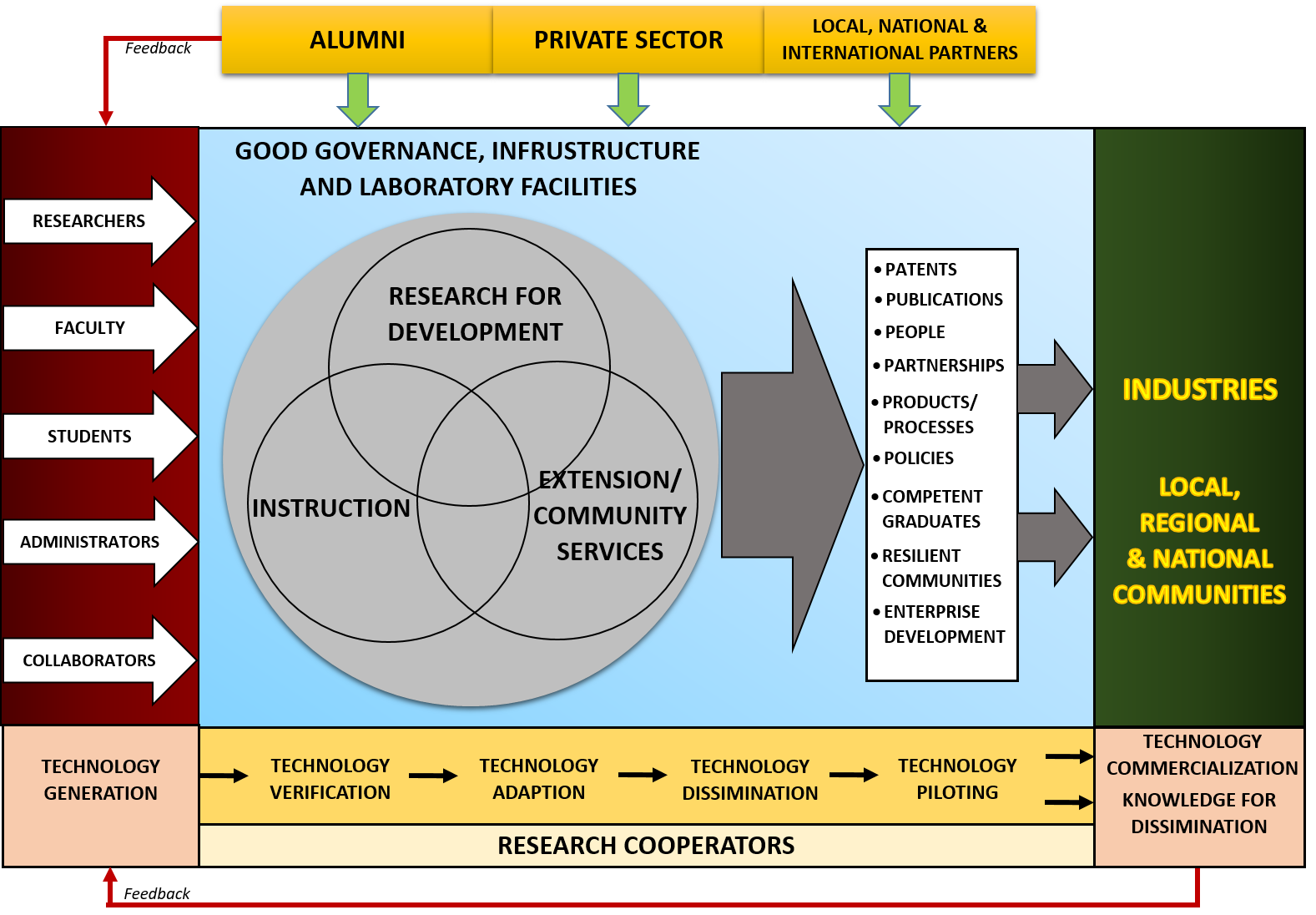
Figure 1. CSU RDE Framework
As the CSU gears up to strengthen its capability in RDE, it needs to embrace and pursue a new RDE
paradigm.
The Sustainable Development Goals (SDGs) have broadened development outcomes from merely increasing
food supply
to include poverty reduction, human nutrition, environmental protection and related issues.
Similarly, AmBisyon Natin
2040 is the anchor of the country’s plans. It envisions Filipinos to enjoy a strongly rooted,
comfortable, and secured
life. As a consequence, RDE at CSU must be linked with the country’s vision and Cagayan’s
development goals to gain more
relevance and have significant impact.
The emergence of global markets and new technologies, particularly ICT and biotechnology has
facilitated a paradigmatic shift in RDE.
Towards this, public institutions like SUCs have adapted to the contemporary setting by redefining
their priorities, changing their
focus towards the poor and marginalized sectors of society.
More specifically, RDE are seeing the emergence of new capabilities, organizations, and
institutional processes where partnerships are
increasingly becoming important. As a result, the process of networking, establishing strategic
alliances and coalition building have become very important.
In the foregoing context, R4D implements RDE programs and projects that has (1) developmental
relevance, (2) links RDE with those who can use it; and (3)
deploys a variety of approaches and strategies to ensure that the results of its RDE work is used
and incorporated into development processes.
CSU should depart from the traditional research and development (R&D) approach and shift to a
research for development (R4D) paradigm.
R4D links research outputs with development outcomes (e.g., poverty reduction, environmental
protection, people empowerment) and priority RDE agenda
is formulated with stakeholder engagement. Likewise, RDE thrusts should be based on market demand
and inclusive, people oriented development (IPOD)
approaches, and conduct Research for Development (R4D).
To ensure research relevance, CSU should efficiently produce the expected outputs of research in a
focused and coordinated manner, to wit: a) information that
advances knowledge; b) usable and commerciable technologies; and c) policy recommendations with
majority of the outputs being usable technologies. Figure below
shows the CSU R4D Roadmap commencing from Research Foundation to accomplishing its desired output.
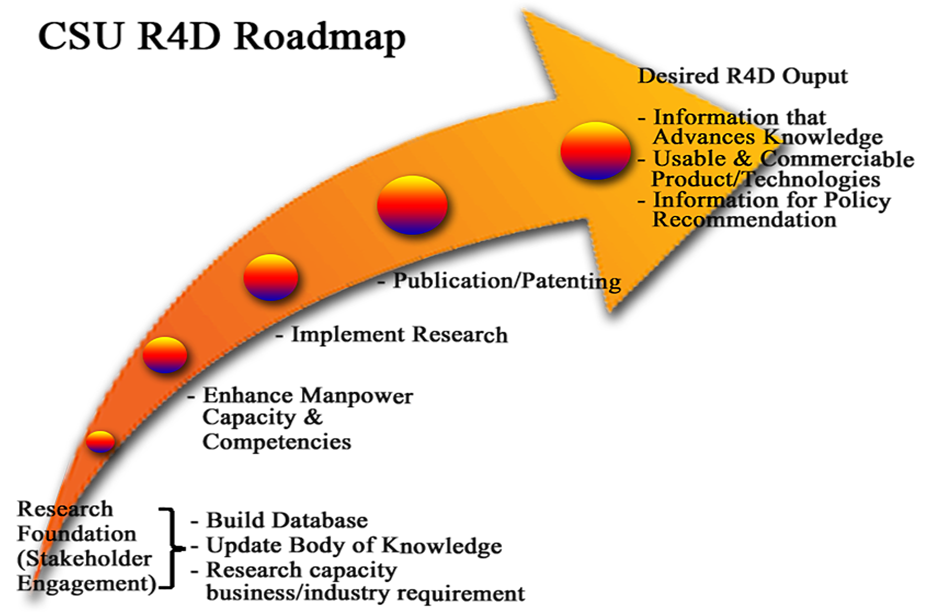
Figure 2. CSU RDE Roadmap
R4D includes the following approaches: 1) analyzing and influencing, 2) advancing innovation, 3)
designing, testing and adapting solutions,
4) increasing access to vital products and services, 5) building communities of knowledge and
practice and 6) supporting local change agents.
The innovation process involves a series of interaction and participation of multiple stakeholders
that operate within a knowledge system. Such interactions result in the initiation, generation,
modification, accumulation and utilization of improved technology.
In the local setting, the innovation process involves the complex, iterative, and dynamic
interaction among various groups of stakeholders involved in the agriculture RDE spectrum.
An innovation system has two broad elements:
- Groups of organizations and individuals involved in the generation, sharing, adaptation, and use
of knowledge of socio-economic significance.
- The institutional context that governs the way these interactions and processes take place which
includes the numerous norms and conventions that shape the way things are done, as well as more
formal institutions such as intellectual property regimes and others.
The innovation process involves not only scientific research institutions, but also a range of other
non-research organizations. Due to the foregoing, innovations come from various sources:
researchers, extension workers, development agencies, farmers, civil society organizations
(CSOs), the private sector and entrepreneurs. The diversity of various actors brings in a diversity
of interests and knowledge systems, which could be both conflicting and complementary.
Innovations and impacts from research in the life sciences (biotechnology in particular) are
increasingly dependent on new groupings, alliances, and relationships within science, and between
science and the private business sector. Hence, the innovation process recognizes the importance
of linkages, communication, public-private partnerships, coalitions and the way these assist
information flows.
Since the innovation process depends on relationships among different people and organizations,
managing these relationships is a central task of RDE. Likewise, the conventions or institutions
governing the way RDE activities are conducted, and the role assigned to different organizations
are pivotal to the innovation process.
In the Cagayan setting, the innovation process involves the complex, iterative, and dynamic
interaction among various groups of stakeholders involved in the RDE spectrum. Hence, RDE must be
carried out with the broad involvement of partners and stakeholders in the province’s development
spectrum.
Moreover, in agricultural innovations systems, CSU adopts a perspective which posits strong linkages
between ecosystems and people. In this context, innovations are embedded in three inter-dependent
and interacting systems: 1) agriculture and fisheries; 2) natural resources; and
3) social systems.
Agriculture innovation systems involve the production, processing and marketing of crops, livestock,
fisheries aqua marine and trees for food, feed, clothing and shelter. Their productivity and
sustainability are driven by changes in climate, technologies and arrangements in the country’s
natural resource systems and ecological services. Social systems are characterized by population
size and quality, culture, peace and order and tenure systems. Finally, governance integrates the
manner how these systems are harnessed for human well- being.